
‘The bad end unhappily, the good, unluckily. That is what tragedy means.’
Tom Stoppard, Rosencrantz and Guildenstern are Dead
The heyday of the disaster film was the 1970s, with a boom generally considered to have been kicked off by the first of four Airport films (1970), and truly set running by The Poseidon Adventure (1972). Before that, however, various films began to set the pattern that would later be followed slavishly by a string of 70s hits and build the audience’s appetite for destruction.
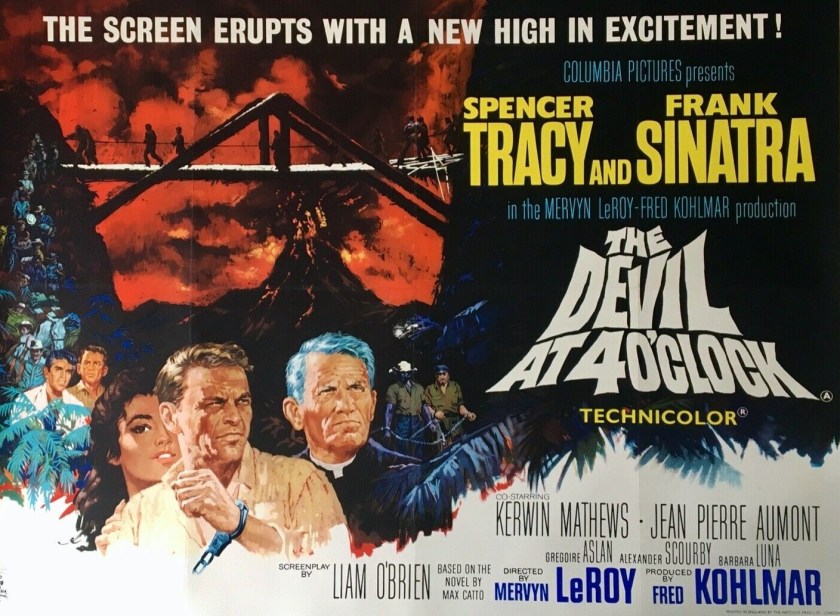
In 1961, almost a decade before the golden age of the disaster film, one film appeared that presaged almost every element of the main cycle of the 1970s and the subgenre’s revival of the late 1990s. It was this film that arguably had the greatest effect in establishing the structure, tropes and cast of characters of the disaster film as it is currently understood, and yet its importance in the evolution of the genre seems under-appreciated if not completely ignored. The Devil At Four O’Clock (hereafter referred to as The Devil) stands perfectly easily alongside The Poseidon Adventure, The Towering Inferno or Earthquake – yet at the time was not defined by its ‘disaster’ subject matter.
Indeed, when The Devil was made, the idea of the disaster film as something distinct within the broader action-adventure genre did not really exist at all.
The plot was as follows: priest Father Perreau and three convicts, Harry, Charlie and Marcel, arrive at Talua, an active volcanic island. Perreau is due to replace the island’s existing priest, Father Doonan (Tracy), who it seems is being recalled to Rome in disgrace. The convicts are due to be taken on to Tahiti for penal servitude, but their pilot decides to stay overnight and as a result, they have to be accommodated on the island. Father Doonan is outraged at the governor’s harsh treatment of the convicts, and demands they are released to his care while they remain on the island. He secures their services to carry out maintenance on the hospital for child sufferers of ‘Hansen’s Disease’ (leprosy), the existence of which has caused tensions between Doonan and the townspeople.
The conflict and the townspeople’s intolerant attitude have led Doonan to question his faith. While at the hospital, up on the slopes of the volcano, Harry (Sinatra) and one of the nurses, Camille (Luna), who happens to be blind, rapidly form an attachment. The following morning, Doonan and Perreau transport the convicts back to the town so they can leave for Tahiti, but an earth tremor triggered by the increasingly active volcano damages the road behind them, making return that way impossible. Meanwhile, the governor, realising that the volcano is building up to a large eruption, attempts to arrange for the evacuation of the island. The tremors worsen, severing the telephone line to the hospital.
Doonan, desperate to return to the hospital and bring out the children, persuades the pilot of the supply plane to parachute him to the hospital. He also persuades the convicts to help him on the promise that he will plead for their sentences to be reduced, despite friction between Doonan and Harry over the latter’s relationship with Camille. They must lead the occupants of the hospital on foot through the jungle, to the port, where a schooner will wait until four o’clock the next day.
They reach the hospital just as it is destroyed, and lead the children and staff on a terrifying march across the island. Numerous trials are encountered by the group – convict Marcel saves a child from quicksand but is killed in doing so; the route is almost cut off by a stream of lava; a forest-fire forces them to shelter in caves, literally praying for rain. Recognising the increasing hopelessness of the situation, and overcoming his prejudice, Doonan marries Harry and Camille. Finally, the party reaches the bridge over a ravine, the last potential obstacle between them and the port. It is standing, but seriously damaged, and convict Charlie and Father Doonan must brace a fractured timber long enough for the rest of the party to cross.
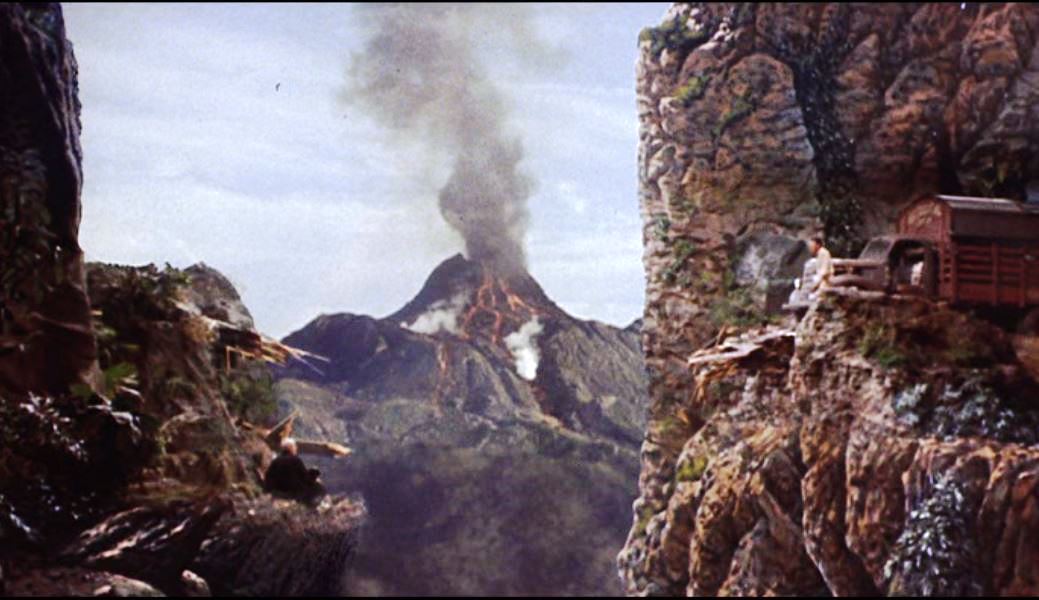
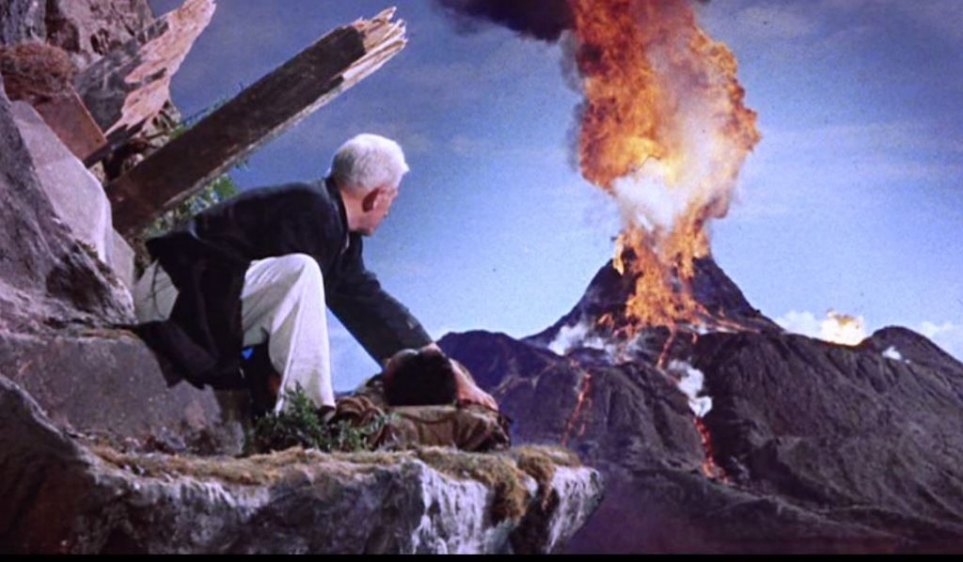
Just as the last of the children cross, a tremor wrecks the bridge and mortally injures Charlie, trapping him and Doonan on the wrong side. Harry leads the remnants of the party to the harbour and safety, then returns to the ravine, even though he can do nothing for the two men stuck on the other side. Harry and Doonan settle the rest of their differences, and Doonan recovers his faith, giving Charlie the last rites before the final, catastrophic detonation of the volcano, which destroys the mountain and then the entire island, as the schooner escapes.
Production
The Devil At Four O’Clock was announced by Columbia in August 1958, based on a novel by Max Catto which had been released that same year, featuring an Irish priest and three convicts attempting to rescue children from a leper colony on a Pacific island as a volcano erupts. Catto was a prolific writer of adventure novels, several of which were turned into Hollywood films, though he is relatively little known these days. Filming was to take place in 1959.
As it turned out, there was something of a revolving door of cast and crew and the filming date slipped. Peter Glenville was hired to direct, before leaving for the theatre as the result of a strike, to be replaced by John Sturges, who was in turn replaced by Mervyn LeRoy. (Interestingly, an early experience of LeRoy was the destruction of his family’s business in the San Francisco earthquake of 1906 when he was six. His best known film at that point was probably The Wizard Of Oz – a ‘disaster film’ of sorts in that a tornado is the inciting incident).
Spencer Tracy was announced early as lead, but just about every other name changed at least once. Initially, Sidney Poitier was named but nothing came of this, and as with the director, several more names came and went before Frank Sinatra was confirmed to play opposite Tracy in the role of Harry, the most prominent of the convicts. At one point it was announced that Tracy was leaving the production, probably due to the delays, given that principal photography had slipped at least a year. Tracy’s failing health could be another reason, though ultimately he stayed on and endured the difficult shoot on Hawaii, which was finished in time for him to carry out promotional activities for another film back in the US.
After a similar process of actors coming and going, female roles were eventually to be taken by BarBara Luna (who was cast thanks to LeRoy seeing her in a theatre production) and Cathy Lewis. The named screenwriter also changed, with Bridget Boland on board from the beginning but replaced by Liam O’Brien in 1960.
Even the filming locations were among the things that changed during pre-production, being initially slated for Martinique before changing to Maui. Given the amount of churn, it seems astonishing that The Devil only took three years to make, and that the results weren’t a complete mess.
Columbia made it clear from the outset that the film would major on special effects. It was in fact the most expensive film the studio had made to date, and was very much in the ‘blockbuster’ category – big names, and no expense spared on the visuals. (That’s not quite true – an early plan to film the VFX shots on Anacapa in the Santa Barbara Islands, an effectively uninhabited islet off the California coast – was rejected on grounds of cost. Even so, the VFX – those produced on location and in miniature – were extensive and expensive). Special effects fell into two categories. Effectively full-size effects on the set in Hawaii and sound-stages/backlots, and miniature effects. The latter principally involved the volcano itself. A huge 1:150 scale miniature of the fictional island of Talua was built in a ‘duck pond’ in farmland outside the Columbia lot at Fallwood, California. This extraordinary model was said to be the largest miniature ever constructed for a film to that point, and it’s quite possible this was true. The ‘miniature’ was 250 feet long and fifty feet tall. Fans were installed to agitate the water for scale effect in close-up shots, and the volcano was rigged for the extensive pyrotechnics required to represent the climactic volcanic eruption.
Relatively little information is available online about the production, with most of the attention focussed on the difficulties between Tracy and Sinatra (the latter, struggling with his health, could only work in the cool of the morning, while Sinatra insisted on only working in the afternoon. It appears the two had little respect for one another).
Some detail about the miniature effects was, however, published in a 2004 article in the San Diego Union Tribune, ‘The De Luz Volcano’. This described the construction of the volcano in the Fallbrook ‘duck pond’ and the process of filming it. According to the caption of an AP press photo from February 1961, the volcano’s peak was made of ‘cork, atop a 50-foot natural hill’, and noted that ‘the 15-foot cone was destroyed in seconds as cameras recorded the scene.’ It’s possible therefore that there were two volcano miniatures – the full island and a separate one of the volcano’s summit.
Some of the close-up shots (presumably those from the scenes when the aircraft flies over the volcano to establish the severity of the eruption) were taken from a helicopter, the cameraman perched on one of the skids. On one occasion, a particularly powerful pyrotechnic went off earlier than the helicopter crew expected and according to the story, almost downed the helicopter, singeing the cameraman’s eyebrows.
The final, catastrophic eruption was filmed on 16 February, 1961, and gave the crew but a single chance to capture the shot. The enormous, elaborate miniature had to be completely destroyed by the pyrotechnics so there was no possibility of trying again if anything went wrong.
The cast never had a chance to see the ‘volcano’ they were acting opposite until the film was released, as the miniature effects were shot after principal photography on Maui, including in the town of Lahaina, in September-October 1960, and then studio scenes shot at 20th Century Fox’s ranch at Malibu, California later in the year. This seems surprising in retrospect as, thanks to a not-inconsiderable number of composite shots, the volcano frequently appears in the background of the location- and studio-shot scenes, and unsurprisingly, the cast are required to react to it. It’s never less than believable that the people on ‘Talua’ believe in the presence of the volcano and are scared and shocked by the eruption.
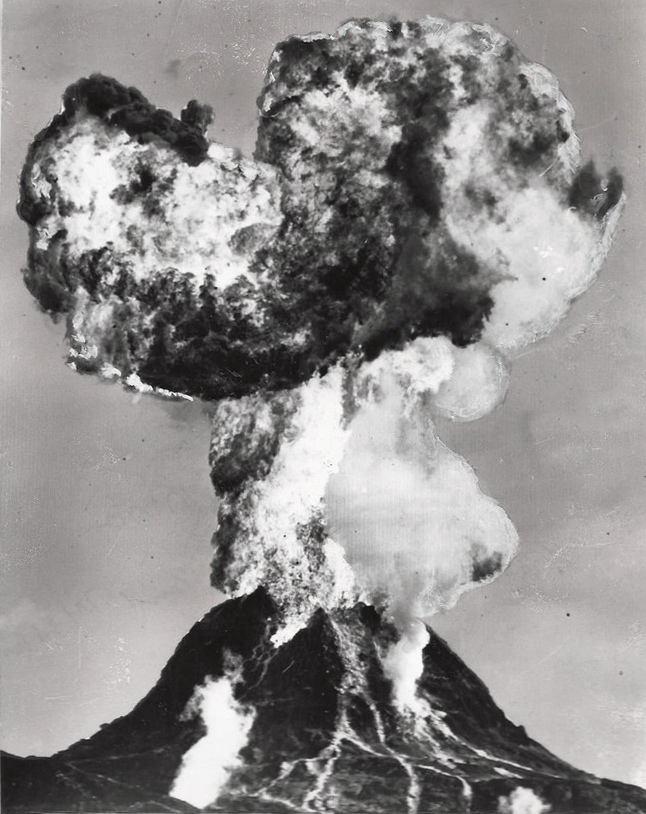
The volcano effects hold up well by any standards. The ‘eruption’ effects seem to be done with the same kind of pyrotechnics used to create explosions and don’t look much like lava, though the streams of lava from the crater look real enough. For me, the close-up shots during the fly-by work rather better than the more distant ones. There’s altogether too much fire and not enough smoke and billowing ash to be totally realistic, but let’s face it, most people expect fire when they think volcano, and in that respect, The Devil certainly delivers.
The on-location scenes in Lahaina are very well done. The earthquake (at almost exactly the halfway point of the film) consists chiefly of camera-shake and things falling over/breaking apart, while residents run around and scream, but in the moment it convinces. Effects such as a mocked-up road with cables underneath so it can shake and split on cue are pleasing. The crew built wooden huts and even a church with an iron spire in amongst the real buildings of Lahaina, so the sight of buildings trembling and falling down is pretty realistic. Again, I was impressed how well the miniature shot, such as one of the radio mast falling – composited in such a way that we see it through the windows of the governor’s office – combined with the full-size footage. These must have been composited using a matte process, rather than filmed together using back or front projection, because the miniature shots were done after principal photography. The only real place in which the combination of shots is very obvious is the flyby of the volcano when miniature shots are seen through the windows of the aircraft, and the join is very visible. (At one point, the use of blue screen even causes Tracy’s grey hair to ‘fuzz’). The sound-stage scenes are obviously filmed on sound-stages, but are OK for all that, and blend in reasonably well.
According to Wikipedia, shots of the eruption have been re-used in numerous other productions, though there’s no indication of which. Subsequent big-budget volcano films (notably the aforementioned Krakatoa, and When Time Ran Out,1980) created their own volcano effects from scratch, so any use of The Devil footage seems likely to have involved television and adverts.
Of particular interest about The Devil is that it follows the structure and tropes of the classic disaster film nearly a decade before the subgenre’s boom – and before the idea of the ‘disaster film’ as a distinct subgenre even existed in the minds of critics and audiences. In most respects, it is as perfect a precursor to the golden age of disaster films as can be imagined. And yet it would have to wait for the 1970s before its successors could thrive. There are many possible reasons for this.
First and most obvious is that the idea of a ‘disaster film’ simply didn’t exist in the way that was later understood, even though all the ingredients were in place. The Devil’s producers clearly didn’t consider it alongside films with a disaster as the set up. The poster proclaimed it to be ‘In the great high-adventure tradition of The Guns Of Navarone [1961] and The Bridge On The River Kwai [1957]’ – rather than, say, The Last Voyage (1960), A Night To Remember (1958) or the 1959 version of The Last Days Of Pompeii, never mind science fiction disasters such as When Worlds Collide (1951). The films Columbia sought to evoke were adventures with action, spectacular visuals and a starry cast rather than a film where the disaster is seen as the main event.
Disaster as a genre
The recognition of the disaster film as a genre or subgenre in its own right seems to have arisen remarkably quickly once the 70s boom in this style of film got going in earnest. Today, the label can apply just as easily to a set-up involving a few dozen people on an aeroplane being in jeopardy or the entire population of the planet, when there is seemingly little thematically to connect them. This was not always the case.
The genre had its first heyday in the 1970s. Box office highlights included Airport (1970), The Poseidon Adventure (1972), The Towering Inferno (1974), Earthquake (1974), Airport 1975 (1975), The Hindenburg (1975), Airport 1977 (1977). Many of these films received multiple award nominations and wins, though the latter were mainly in the technical categories. The subgenre began to die out when box office takings began to plummet in the latter part of the decade, with films such as The Swarm (1978), Meteor (1979) and The Concorde…Airport ‘79 (1979) performing poorly. The formula that had created blockbusters at the beginning of the 70s had worn out its appeal by the decade’s end – indeed, it was well into its decline by the middle.
In the 1990s, however, the form experienced a revival, utilising almost exactly the same basic plots and themes as the 70s boom, and taking advantage of advances in visual effects (and the cost-effectiveness thereof). The nature of the disasters repeated just as closely – shipwrecks (Titanic, 1997), science-fiction speculated natural threats (Armageddon and Deep Impact, both 1998, The Day After Tomorrow, 2004), science creating or enhancing monsters (Jurassic Park, 1993, Godzilla, 1998, Eight-Legged Freaks, 2002), and of course, the good old volcano (Dante’s Peak and Volcano, both 1997, Supervolcano, 2005).
The pattern is by now highly familiar – a group of people brought together by circumstances are forced to work together to survive a catastrophe, or the threat of one. Elements of the formula which crop up again and again comprise spectacular special effects and an ensemble cast including at least a couple of big stars, making disaster films among the most expensive to produce. Structurally, a series of sub-plots tend to be established before the main disaster occurs, (usually at least one romantic) and which complicate the efforts to escape or avert the disaster; plenty of conflict from personality clashes and power dynamics within the group; at least one heroic sacrifice; a set-piece climax in which the jeopardy is at its highest. It would not be exaggerating too greatly to say that in many cases, individual films are only differentiated by the nature of the disaster.
Before the short span of years in which the ‘disaster film’ was codified, rose, fell, and was incorporated into the battery of action-adventure subgenres, there were plenty of films that essentially followed the same pattern. Interestingly though, there is little evidence that they were seen as in any way separate from the broad swathe of action-adventure films. The story of a disparate group of people facing some kind of catastrophe, be it a natural disaster or something like an aircraft crash or shipwreck, was after all hardly new, even in the 1960s.
By the beginning of that decade there had been no fewer than eight films based (most of them very loosely) on Edward Bulwer Lytton’s novel The Last Days Of Pompeii, set during the eruption of Vesuvius in 79 CE. The excavation of Pompeii in the 18th and 19th centuries, had had a huge influence on art – Joseph Wright painted some thirty scenes based on the eruption of Vesuvius (almost certainly from imagination, as although there were eruptions of the mountain in his lifetime, his known visits to Naples did not coincide with them). The painting The Last Day Of Pompeii by the Russian artist Karl Bryullov did a huge amount to set the aesthetic. The excavation seems to have affected the popular psyche profoundly. In particular, the casts of humans and animals frozen forever at the moment of death contrasted sharply with the beautifully preserved frescoes and mosaics depicting the same people and animals in life. This told its own powerful story of the terror and anguish of an entire town wiped out by a natural disaster.
It was entirely understandable therefore that people wanted to explore the human experience of something so traumatic more deeply. The sheer power of a volcanic eruption would have been made even more starkly obvious by the eruption of Krakatoa in 1883. The nature of Empire meant that many Westerners would have lost relatives and friends, and the survivors were on hand to tell the tale in their own languages. Moreover, the global effects of the eruption on the climate give the sense that it doesn’t matter how far you run, the volcano can still reach you. The related phenomenon of the earthquake seemed to have a similar appeal to early 20th century filmmakers, with half a dozen portrayals of the 1906 San Francisco earthquake and related fire, mostly as a backdrop event but in a few cases, constituting the main action.
The other major event that seems to have fed into the evolving disaster film genre was the loss of RMS Titanic in 1912. By the 1960s there had been almost as many portrayals of that event in film as the destruction of Pompeii. It seems to be these large-scale real-life disasters that created the interest in artistic explorations of disaster, and, importantly, shaped the perceptions of two of the forms disaster can take in film – the natural disaster and the ‘transport’ disaster, the iceberg and the freezing sea arguably forming a connection between the two. The next step was for the disasters themselves started to become fictional.
It’s not clear to what extent in the 1960s the notion of a disaster film – as opposed to an adventure or drama that happened to feature some kind of disaster – existed at all, but the structure and tropes were clearly beginning to take shape. In 1960, The Last Voyage was released. This might easily have been yet another version of the Titanic story – much of the set-up is identical to most Titanic films – but instead had a contemporary setting and featured a fictional liner sinking by the bow following a boiler explosion rather than a collision with an iceberg. Suspense was a big selling point, with a race against time for the main character to save his trapped wife as the liner sinks – it was billed on posters as ‘91 minutes of the most intense suspense in motion picture history!’
Today, mention of the term ‘disaster film/movie’ would automatically include science fiction versions of the set up. Anything including global apocalypse tends to fall into this category as something that possibly could happen, rather than an examination of something that had really happened (e.g. the destruction of Pompeii) or a fictional instance of something that does really happen (a natural disaster such as a hurricane or earthquake, or an industrial disaster). This manner of film had become increasingly popular through the 1950s, largely, it seems, spurred by the horrifying destructive power of nuclear weapons and Cold War rendering their use all too possible. The monster movies The Beast From 20,000 Fathoms (1953), Gojira (1954) and The Deadly Mantis (1957) take what is today recognised as the disaster set-up but with an atomically awakened or mutated creature acting as the destructive force. When Worlds Collide (1951) on the other hand involves a speculative natural (if implausible) disaster of the Earth being destroyed by a wayward star. The Day The Earth Caught Fire (1961) features science gone wrong – simultaneous American and Soviet nuclear bomb tests generate unforeseen effects and threaten to destroy the entire planet.
The disaster boom
Producer Irwin Allen (who became known as the ‘Master of Disaster’) set out his basic formula during an interview with Variety the year The Poseidon Adventure was released: ‘We have the perfect set up of a group of people who have never met before and who are thrown together in terrible circumstances.’ He adds, with a somewhat gloating tone, that ‘In the first six minutes, 1,400 people are killed and only the stars survive.’
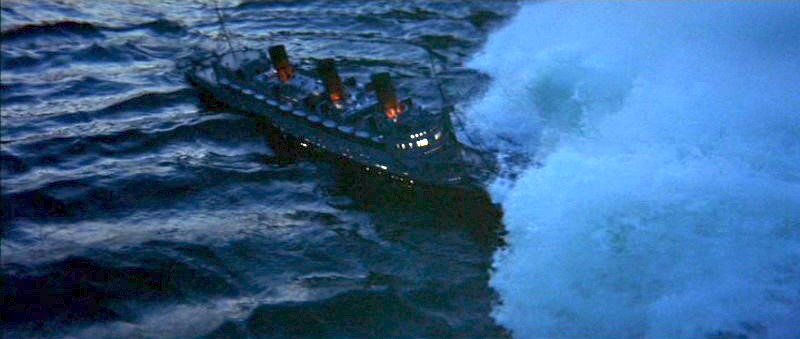
That comment raises another staple of the disaster film – a high death toll, or at least the ever-present potential for a high death toll. Often, the disaster film asks the audience to care about the survival of a small group of people while ignoring the deaths of a much larger group. But why should this be?
In a world where the hope of the postwar decades gave way to Vietnam, the Oil Crisis, Watergate, there seemed to be something strangely appealing about watching either nature strike back against the hubris of mankind, or men causing their own destruction through that same hubris. The 1970s could be seen as another ‘low, dishonest decade’, as WH Auden termed the 1930s. This cynicism and nihilism appears to have found its expression in films offering visions of widespread destruction, in which the unworthy and a fair number of the worthy perish.
There does not appear to be any real sense at this stage of any thematic link between films featuring natural disasters and those featuring a ship or aircraft in distress. It’s possible that this link was not fully formed until The Poseidon Adventure, where a natural disaster – a tidal wave – causes the shipwreck, even though Irwin Allen’s ‘perfect set up’ could arguably describe The Devil. BarBara Luna’s role in The Devil led to her being cast in Around The World In Eighty Days, another 60s adventure – but one that had nothing to do with disasters. It seems the volcano was incidental.
The next big volcano themed film, Krakatoa, East of Java (1968), had the distinct feel of a more traditional adventure more than it was a proto-disaster film. It had all the potential ingredients of a partner piece to The Poseidon Adventure, Earthquake, or City On Fire (1979), and yet in tone it is very different. Its underwater hunt for treasure and balloon exploration sequences make it as much a successor to 20,000 Leagues Under the Sea (1954) and Around The World In Eighty Days (1956) as it is to The Devil. A disaster in the film did not yet betoken a disaster film.
Nine years after The Devil was released, Universal’s adaptation of Arthur Hailey’s 1968 novel Airport is generally reckoned to have initiated the boom in disaster films. Like The Devil, it was a lavish adaptation of a recent hit thriller novel, and it featured big stars as part of an ensemble of characters rather than focussing on just one or two. Like The Devil, it featured a plot full of suspense. Unlike The Devil, the disaster was entirely human in its instigation, although the main action is set against the background of a blizzard. This aspect suggests a further link between the disaster film and the implacable power of nature which would become such a feature of the subgenre.
In 1973, Vincent Canby coined the term ‘ark movie’ to describe what is now understood as a subset of the disaster movie:
‘ARK movies are easy to describe: a group of assorted characters (two of each is the accepted way) are put aboard an ocean liner, in an airplane, or maybe on a bridge that clearly looks unsafe to us but to no one within the film. In short order (the shorter the better for this sort of thing to be successful), the bridge collapses, the ocean liner starts sinking, or the airplane threatens to crash (though two out of three times it doesn’t), which is the easiest way to explain survivors in Ark Movies about airplanes, most air crashes being so fatal.’
(What Makes ‘Poseidon’ Fun? Vincent Canby, New York Times 14 January 1973)
He gives examples such as Airport, The High and The Mighty, A Night to Remember, Titanic, and Phone Call From A Stranger, adding ‘This may sound as if I have a peculiar affection for disaster, at least on the screen.’
The affection would soon not be considered peculiar, at least not among filmgoing audiences. And yet the formula, where a natural disaster could take the place of the failure of an aircraft or ship, was clearly not yet universally recognised.
It is, after all, called The Poseidon Adventure, not The Poseidon Disaster.
And yet, within a few years, the connection would be sealed. The films that followed The Poseidon Adventure, and sought to capitalise on its appeal, chiefly focussed on natural disasters – or at least, static ones. While plenty of ‘Ark Movies’ went into development around this time (notably a depiction of the Hindenburg disaster, and the first sequel to Airport), the two films that turned a one-off success into a boom were The Towering Inferno (1974), and Earthquake (1974). Both of these followed the formula set by The Poseidon Adventure, and pioneered by The Devil, almost precisely. In the former, the ‘Ark’ isn’t going anywhere. In the latter, there is no Ark.
A disaster movie does not necessarily need an Ark, but it definitely needs a flood.
Character-building
Irwin Allen’s ‘perfect set up’ in which ‘only the stars survive’, interestingly, identifies the main point of difference between his film and the source novel by Paul Gallico. In the latter, the main group of survivors experience horrific and frequently fatal trials trying to reach the stern, which they believe is the only way out, only for the survivors to find that many more people escaped via the bow, finding it easier and safer. In the film, escape via the stern is revealed to be the correct decision, and therefore the sacrifice of the characters who died along the way, and the suffering of those who did not, was not in vain.
And the sacrifice is a big part of the appeal. The stars might all survive the initial onslaught, but they most certainly won’t all make it to the end. The Poseidon Adventure may have also kicked off the ‘Anyone Can Die’ trope, in which the early death of a well-publicised and high profile cast member indicates to the audience that no-one is safe, and even the most famous lack ‘plot armour’. Roddy MacDowall appeared prominently in publicity for the film, but his character barely makes it out of the ballroom.
The Poseidon Adventure also introduces the disaster subgenre’s least appealing characteristic – a judgemental and often prudish morality. This morality does not necessarily decide who lives and who dies, but it often seems to shape how people die and frame the audience’s attitude. Presumably the reasoning is that the audience must be given reasons to accept certain deaths – even to enjoy them.
There are generally two forms this characteristic takes. Most obviously, among the cast of first and second tier characters who are inevitably weeded out on the road to survival, we are presented with early hints as to the manner in which we are to accept their deaths. Corruption and avarice are a giveaway, as is any kind of sexual immorality. It is hard not to conclude that Lynda Rogo’s fiery death in The Poseidon Adventure was made inevitable by her former life as a sex worker. She is literally a fallen woman. The same fate is allotted to Lorrie, a character in The Towering Inferno, seemingly for the sin of having sex on work time earlier in the film. Equally bigoted is the treatment of Belle (Shelley Winters) who dies of a heart attack after saving the life of Rev Scott because, it is strongly implied, of her obesity.
Additionally, many, usually anonymous, characters are condemned for simply following the direction of an authority figure who inevitably makes the wrong choice and opposes the hero’s plan for survival.
The Devil, in contrast to the Irwin Allen blockbusters of the 70s, does not doom the majority for making a wrong choice or for simply not being played by a recognised star. Most of the islanders escape on the freighter that the governor calls in when it becomes apparent that the eruption is going to be serious. There is no moral decision that the majority make or is made on their behalf, e.g. by an authority figure, that condemns them to a deserved death.
In The Poseidon Adventure, however, the shipowner’s representative, Linarcos, insists on maintaining a high speed in poor weather to save the company money, endagering the ship’s stability. Later, the purser persuades the majority of those who survived the capsize to stay put in the ballroom. In The Towering Inferno, subcontractor Simmonds cuts corners with the electrics, then builder Duncan refuses to evacuate when the inevitable fire starts.
Indeed, one of the few tropes common to the 1970s-2000s disaster films that is not quite fully formed in The Devil, is that of the small-minded, cowardly or corrupt bureaucrat whose actions exacerbate the disaster. The behaviour of these characters provides a contrast with the heroism of the main characters, and a human antagonist to align with the disaster, providing a human face to offset the impersonal nature of the disaster itself.
In The Devil, on the other hand, the main authority figure, the governor, who was introduced unsympathetically, over his treatment of the convicts, acts responsibly when it comes to the eruption. He organises the resources at his disposal decisively, and effectively saves the lives of the majority of the islanders. Crucially, he also sanctions the use of the island’s only aeroplane to parachute Doonan and the convicts to the hospital in an attempt to save the patients and staff, though he clearly thinks the effort is pointless. The governor is obviously an unpleasant character on a personal level, and his inhumane treatment of prisoners, and his antipathy towards Doonan and the leper colony (which he shares with the majority of islanders) initially paints him squarely as a bad guy. Nevertheless, when disaster strikes, he is quickly redeemed. Allen and the other disaster boom directors would not have discarded a potential enemy so readily.
In fact, for much of the film, the governor is effectively right about Harry and his compatriots. On the morning of the eruption, they try to escape, and when they run into Father Doonan as the priest is looking for volunteers, they are on their way to rob the poor box. Harry is more of an anti-hero than a hero until the film’s final act.
It is not just temporal authorities that receive very different portrayals between The Devil and 70s disaster movies. Divine authority is an important theme in each. The Poseidon Adventure in particular effectively reverses the final revelation of The Devil. In the earlier film, Father Doonan recovers his faith, shown the light by the actions of the three convicts who ultimately sacrifice themselves. Indeed, the parallels between Doonan and Jesus, dying alongside three criminals to save the innocent, are hard to miss, especially given the musical cue at the climax of The Devil which would have been quite at home in a Biblical epic.
Gene Hackman’s Father Scott, on the other hand, violently loses his faith, and dies raging against God. His sacrifice is active rather than passive. This is an aspect of the 1970s disaster film – a questioning of all authorities, up to the very highest – which probably could not have found expression in the early 60s, at least not in a mainstream, big budget film. The Devil provided a pattern that allowed the filmmakers of the next decade a way to rail against authorities with feet of clay, and express their helplessness in the face of implacable forces and seemingly inevitable decline. But the 1961 film was not ready to do more than look sideways at authority structures before ultimately working with them.
Casting
The all-star cast was of course a feature of the disaster boom, but even this had been presaged by The Devil. The explosive combination of Sinatra and Tracy presaged later films where two leading men of equal box office heft team up, notably the pairing of Paul Newman and Steve McQueen in The Towering Inferno, and Jack Lemmon and James Stewart in Airport ‘77. It is not too much of a stretch to suppose that stories of the on-set tension between Tracy and Sinatra generated a further spark of interest in the film, and tales of big stars and bigger egos behind the scenes could be relied upon to boost publicity in a production.
One aspect of 70s disaster film casting that seems striking is the extent to which the main players reappear. George Kennedy, who appears in all three Airport films, also plays a police officer Lew Slade in Earthquake. Charlton Heston plays the leading role in both Airport 1975 and Earthquake. William Holden is the antagonist in both The Towering Inferno and When Time Ran Out.
The latter actually featured something of a who’s who of 70s disaster films. In addition to Holden, Paul Newman, Red Buttons and Ernest Borgnine also reappeared from earlier Irwin Allen productions. These recurring actors lend the slew of disaster films a related feel, like a broad, sprawling franchise; a kind of Cinematic Universe of catastrophe. (Arguably, the same thing had happened with the earlier boom of biblical-historical epics, with actors like Charlton Heston, Alec Guinness, Sophia Loren, Douglas Wilmer and Stephen Boyd cast in numerous otherwise unrelated examples).
The casting of veteran actors in the twilight of their careers in quickly became a feature of the disaster boom. This tended to manifest itself in cameo roles, the ensemble nature of the typical narrative with its multiplicity of subplots lending itself to small but notable – and manageable – roles. Fred Astaire playing an ageing confidence trickster in The Towering Inferno brought a touch of the Hollywood golden age that was repeated in several succeeding disaster films. This included women as well as men – Olivia de Havilland appeared in Airport ‘77 and Gloria Swanson even played a fictionalised version of herself in Airport ‘75. These roles can be traced back to Tracy’s performance in The Devil. It’s tempting to consider that the difficult time Tracy experienced during the tough shoot recommended that leading roles for older actors was inadvisable, Lemmon’s turn leading Airport ‘77 aside.
When ideas ran out…
Arguably, the film that sealed the first decline of the disaster film was Irwin Allen’s last effort at the subgenre, When Time Ran Out… (1980). Ironically this was not just another volcano film, but essentially a retread of The Devil – the film that had done so much to formulate the subgenre.
When Time Ran Out’s lengthy development made The Devil’s look straightforward. It started out as an adaptation of Gordon Thomas’ and Max Morgan-Witts’ The Day The World Ended, a narrative nonfiction book on the 1902 eruption of Mont Pelée on Martinique that destroyed the city of Saint-Pierre, killing around 30,000 and leaving only a few tens of survivors. The premise seemed perfect. A spectacular natural disaster coupled with a shameful failure of authority that led to obvious warnings being ignored, a dizzying death toll and a handful of survivors who endured unimaginable ordeals. When the book was released in 1975, it became an instant bestseller, and Irwin Allen, on the crest of a wave from his first two disaster spectaculars, snapped up the rights.
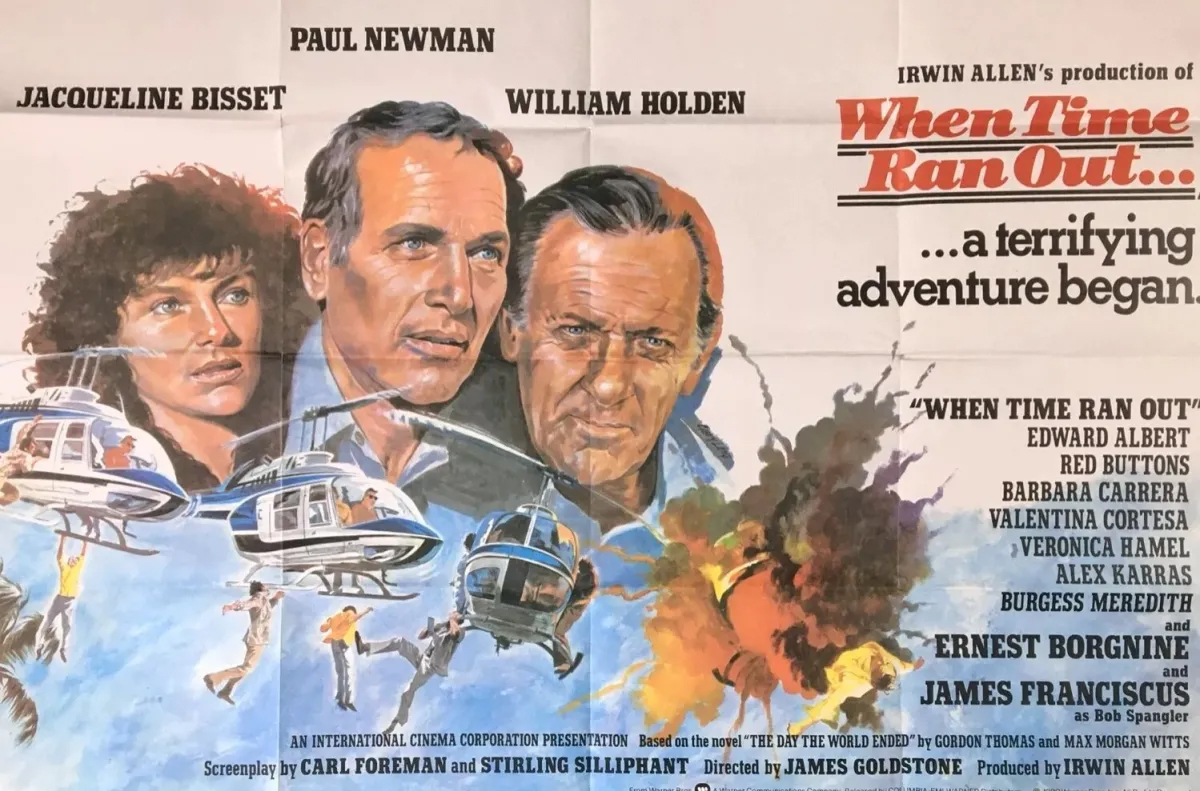
Allen was working at a furious pace in the wake of his successes. In July that year, Allen announced he would make three films for 20th Century Fox (The Day The World Ended, Beyond The Poseidon Adventure and a film called Circus, possibly a sequel to or remake of his 1959 film The Big Circus), as well as another two films for Warner. Several television pilots were already in production, as was The Swarm, an adaptation of a novel about an attack of killer bees.
The Day The World Ended entered pre-production in late 1975, shooting was due early in 1976 for a release later that year. But the wheels were already starting to come off the disaster juggernaut.
Abruptly, Alan Ladd, the head of creative affairs at Fox decided that the disaster boom had peaked and declined to fund Allen’s slate. Perhaps he saw that the market was reaching saturation – 1974 had seen three big-budget disaster films released, with Fox and Warner’s The Towering Inferno, and Universal’s Earthquake and Airport 1975, all hitting cinemas in the last three months of the year.
Allen was still considered a sound investment though, and Warner, which had co-produced The Towering Inferno, agreed to fund his projects. Indeed, for his volcano film, Allen secured his biggest budget to date, $20 million.
The delays involved in switching production companies put The Swarm and The Day The World Ended back years. In the meantime, two films completely changed the face of blockbuster cinema – Jaws in 1975 and Star Wars in 1977. The formulaic disaster film was already beginning to seem old hat. Jaws, while following many of the beats of the disaster film, brought a nuance to the writing and characterisation, that made the disaster boom films seem juvenile, while its intimacy made them seem impersonal. Then, Star Wars blew away the genre’s bleakness and cynicism with a sense of new hope (pun intended). Both retained the emphasis on spectacle while doing something fresh with it.
Against this backdrop, development of Allen’s disaster films continued. The Day The World Ended went through significant changes from its original form. It would no longer be based on the 1902 Mont Pelée eruption, but would instead have a contemporary setting like Allen’s other disaster films; and the title changed to When Time Ran Out.
By this time, the narrative of When Time Ran Out echoed The Devil At Four O’Clock in most of its important respects including the basic structure, the working-class hero Hank Anderson (Newman) and the climactic ordeal. The only major departure was the absence of religion. In another irony, the volcano film in which the two main characters survive turned out to be far more dark than the one where they both died.
In just about every aspect, the newer film is inferior, and this has little to do with Warner cutting the budget once production had already started, bringing it more into line with the likes of Jaws and Star Wars. The real problem is the script, and Allen’s insistence on slavishly following the formula that he believed had served him well up to that point. He had failed to learn the lesson of Jaws and Star Wars, and arguably missed what people had really responded to in The Poseidon Adventure – compelling and relateable human stories. This might have mattered less had the script been any good. Sadly, the characterisation was thin, the set-up implausible, the effects increasingly poor, and the ending ludicrous.
In When Time Ran Out, residents of a hotel on a Pacific island face a live volcano, after the owner covers up the detection of signs that an eruption is imminent. When the volcano blows, lava begins to build behind a ridge. When it overflows, the hotel will be engulfed. While the majority elect to stay and await rescue or the lava, whichever arrives first, a small band led by Hank elects to walk to safety. They are forced to undergo a challenging march across the island, as in The Devil, and the climax once again involves a damaged bridge over a stream of lava. Instead of the entire island blowing up, the volcano contrives to direct a vast and perfectly aimed lava bomb onto the hotel, destroying it completely and killing everyone who had remained there. Presumably this was forced by the last minute cuts to the visual effects budget, as it makes little sense in terms of the narrative. The ending set up by the story, with lava overtopping the ridge and overwhelming the hotel, was, one assumes, too expensive to realise.

When Time Ran Out shows the limitations of retreading the same basic tropes but with different disasters. Paul Newman reprised his leading role from The Towering Inferno, largely for contractual reasons, and his performance is unenthusiastic – he later admitted it was the only film he had made solely for the money. The action is somehow both predictable and unbelievable, and although the visuals are sometimes impressive, the overall experience is forgettable. Indeed, the plot is so formulaic and the deaths effected with such casual cruelty that the film leaves a bad taste in the mouth.
Allen seems to have responded to script problems by copying scenes from his disaster hits. At times, the script of When Time Ran Out follows the beats of earlier films so slavishly that the action becomes nonsensical. For example, after learning that lava from the erupting volcano is heading for their hotel, the guests panic and flee. Many try to board a just-departing helicopter, leading to it crashing and killing all on board. This is a clear retread of the moment in The Towering Inferno when men crowd onto a bosun’s chair on a cable to a neighbouring building, and fall to their deaths. But moments after the helicopter crashes, Spangler, the hotel manager convinces the majority that they are safer staying put, this time recalling the Poseidon Adventure’s purser doing the same with the guests in the ballroom after the ship capsized.
This serves the plot in the sense that it condemns the majority to death by their own passivity while affording a small group of more worthy characters the chance to escape. But run together with the helicopter scene as it is, the progression makes little sense – people who moments before had been desperate to escape were now determined to meekly await rescue, and refused to take action.
Only as references to earlier films do they follow any kind of logic. As in Allen’s earlier films, characters are punished with violent deaths for adultery, dishonesty, avarice, not being white, or not being played by a famous actor – and of course passivity, and following the advice of a traditional authority figure.
The end of the end of the world
When Time Ran Out bombed. It made $3.8 million at the box office, a bad loss even considering the later cut to the original $20m budget. Perhaps its failure cannot be entirely placed at its own door, as by the time it appeared in 1980, a string of inferior disaster films in the second half of the 1970s had well and truly demonstrated that the genre was in decline. This was most obviously indicated by the appearance, the same year as When Time Ran Out, of Airplane!, a knockabout parody of disaster films. Leslie Nielsen, who had appeared as the earnest captain of SS Poseidon in The Poseidon Adventure, and the mayor in City On Fire, was so effective at deadpanning Dr Rumack in Airplane! that it virtually made a comic actor of him overnight. The popularity of a film mocking disaster tropes and characters marked the true demise of the disaster boom. When Time Ran Out was merely the signature on the death certificate. Allen’s last major disaster blockbuster was probably doomed to failure. If it had had anything to recommend it as a film, it might have enjoyed a later resurgence. As it was, after the striking opening sequence in which a silver-clad figure eerily crosses a vast old lava field, When Time Ran Out is only worth watching to see how not to make a disaster film. When watched back-to-back with its inspiration and clear influence, The Devil At Four O’Clock, its inferiority is all too apparent.
This is not to say that The Devil is perfect, by any means. The pace sags in the middle, when the meditation on faith is allowed to meander more than it needs to. The romance between Harry and Camille feels implausibly fast, though it does provide grounds for conflict between him and Doonan. Some of the compositing is a little creaky by today’s standards. The Devil can seem rather formulaic, with plot points guessable well in advance. When we are introduced to the vertiginous and crumbly road, and the only bridge, it is pretty easy to guess the role they will play later on. In part, however, this predictability is because of how often those plot points have been followed since.
The greatest differences between The Devil and its successors were in the underlying messages and tone. The Devil ends with Father Doonan recovering his faith, while Harry discovers his respect for the priest and his own nobility, and willingly sacrifices himself alongside Doonan. We are left with the sense that humans are powerless before God and nature (which is ultimately a manifestation of the power of God) and while our faith may be tested, God will always lead us back. For all that it is routinely referred to as ‘the devil’, the volcano is portrayed as something implacable and unavoidable – it merely is. The structures by which man exists – governments, the church – may sometimes let people down, but ultimately they stand firm in the face of disaster. By contrast, the outwardly similar Poseidon Adventure shows us that authorities are corrupt and venal (ship-owner Linarcos), ineffectual (the Captain), or cowardly and foolish (the Purser). Those archetypes were seen again and again throughout the 70s disaster boom.
Moreover, God is not just ambivalent but antagonistic. By the climax, Father Scott’s previously rock-solid faith is destroyed, and Rogo – the blue-collar analogue of Harry – similarly loses his faith in Scott. The fact that a handful of innocents survive is incidental to the avoidable tragedy, and the wrecking of Scott’s belief system. His sacrifice is still somewhat Christ-like, but he dies knowing that he has saved not mankind but six people of 1,400, now including two widowers whose wives failed to survive the journey, and who are broken by the loss. The elements that aim to lighten Poseidon Adventure – the chirpy child, Robin, the burgeoning relationship between lonely bachelor James Martin (Red Buttons) and bereaved singer Nonnie Parry (Carol Lynley) – do little to leaven the film’s darkness. Indeed, most often they just seem jarring.
By contrast, Gregoire Aslan’s convict Marcel provides genuine comic relief in The Devil, and is one of the more memorable human elements. By 1974, such lighter elements had all but been abandoned. Joy is obtained mainly by seeing the deserving get their comeuppance. The ending of most 70s disaster films are muted, while the ending of The Devil is glorious. As the Talua volcano finally explodes, we feel worthy of Doonan’s love, his sacrifice. As the Aéronavale helicopter lifts off the hull of the Poseidon, on the other hand, we can but forlornly hope we would have been worthy of Scott’s. By the time Chief O’Halloran drives away at the end of The Towering Inferno, we know God is dead, and can but hope men stop trying to take his place. Had The Devil at Four o’Clock been made in the 1970s, it might well have been superficially similar but tonally very different. In 1961, audiences could watch the world burn, but it took the 70s to make them want to.
Why?
It was said of the Roman Empire (in the film The Fall Of The Roman Empire, anyway) that it provided historians with two problems – how to account for its rise, and how to account for its fall. The same might be said of the disaster movie boom. It appeared seemingly out of nowhere, and within a couple of years was dominating the list of big studio releases. Within another two or three years, audiences were turning their backs.
Most cinematic booms tend to last around a decade, this being about long enough for studios to respond to a hot new thing, then follow up their own successful projects once or twice before output becomes formulaic and audiences become bored.
A theory has been espoused by Mark Kermode and others that the disaster film replaced the war film. The disaster film could act as a surrogate, with a ‘squad’ facing adversity in ‘enemy territory. The suggestion is that the Vietnam War had turned audiences against war as a subject and setting, but still keen to see spectacular action and characters in extremis. There does seem to have been a drop-off in major war films in the first half of the 1970s, from the US at least. After Tora Tora Tora, Catch-22, Kelly’s Heroes and Patton all came out in 1970, there does not seem to have been a major studio war film until Midway in 1976, though this marked the beginning of a resurgence.
On this basis it would not seem coincidence that in several disaster films, the day is saved through things being blown up. In The Towering Inferno, Newman’s and McQueen’s characters dynamite the water tanks to put the fire out. In Meteor, a battery of ICBMs break up the asteroid.
Another genre of film that could be argued have been supplanted by the disaster film is the ‘sword and sandal’ epic. This was a type of film with unusually long-lived appeal, going back to the pre-war era, but a late-50s/early 60s boom reached its peak with Ben-Hur (1959), Spartacus (1960) and El Cid (1961) before beginning a decline, appropriately enough, with The Fall of the Roman Empire (1964) and ended, inappropriately enough, with The Bible: In The Beginning… (1966).
These films shared many features with the disaster boom – star-laden casts, an emphasis on visual spectacle with lavish sets and thousands of extras, long run-times, huge budgets, and Charlton Heston. They were complicated and expensive to make, so when audiences began to desert them, the end was swift. The decline of religious sentiment in the 1960s invariably meant audiences were less interested in cinema exploring the Judeo-Christian tradition or the origins of ‘Western Civilisation’.
Unlike the sword-and-sandal epic, however, the disaster boom, once it was understood as a phenomenon in its own right, provided a suite of ideas, characters and beats that could be readily incorporated into action and adventure films more widely. Most recently, superhero films such as the Avengers films, DC’s Man of Steel and Christopher Nolan’s Batman trilogy adopted many of the recognisable features of the disaster film. Cataclysms are brought about either by the superheroes or their adversaries, and the consequences play out as in more straightforward disaster films.
Yet the disaster film itself remains distinct. It experienced a second boom in the 1990s, as the advent of digital effects allowed spectacular visuals without the necessity for complex and expensive physical effects. The market can still sustain the odd individual disaster film, such as yet another version of the AD 79 Vesuvius eruption (Pompeii, 2014). Perhaps, with the collapsing climate and associated extreme weather events, floods and fires, the disaster movie will find a new era of relevance. It is to be hoped that it will be the self-sacrifice and hope of The Devil At Four O’Clock that characterises our response, and not the cynicism and petty vengefulness of Irwin Allen’s ‘perfect set up’.
 Air and Sea Stories
Leave a comment